Mapping Dynamic, Hierarchical Quantum Circuits
By Marouane Benbetka 1, Merwan Bekkar 1, Bokyeong Yoon 2, Riyadh Baghdadi 1, Martin Kong 2
1 New York University, Abu-Dhabi, UAE
2 The Ohio State University, Columbus, USA
Abstract
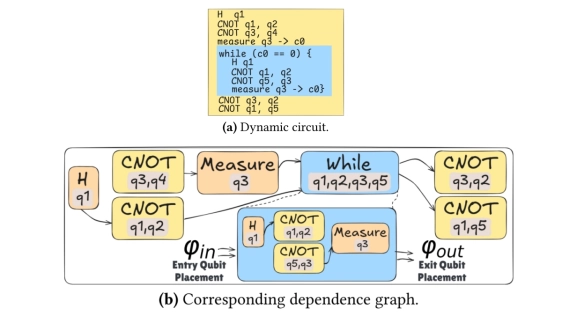
Qubit mapping is a critical pass in quantum compilation. Despite various advances, dynamic circuits, those exhibiting data dependent control-flow, often resulting from qubit measurements, are not yet supported by the vast majority of available qubit mappers. The crucial limitation to overcome is the dependence on flat, one-dimensional representations of circuits. Further, qubit mappers currently lack compiler abstractions that capture the hierarchical nature of circuits, hindering the qubit mapping process.
In this paper, we introduce a new qubit mapping method and analyses to tackle hierarchical dynamic circuits. Our novelty resides in four key aspects: modeling (statically) sub-circuits in disjoint control-flow paths, introducing a novel Qubit Reconciliation pass to maintain consistency between sub-circuit and control-flow boundaries, a loop-entry remapping pass, and a refined cost function enhanced for SWAP count, circuit depth, circuit latency and error. We demonstrate the efficiency of our approach on a wide range of dynamic circuits on two monolithic Quantum Processing Units of 127 and 156 qubits, and on chiplet hexagon-based QPUs. On monolithic QPUs, our qubit mapper improves the SWAP count by up to 52%, depth by up to 18%, latency by up to 18.6%, and error by up to 40%. On chiplet architectures, we achieve improvements of up to 36% on SWAP count, 8.7% on depth, 15% on latency, and 15% of error.
Keywords: Hierarchical Circuits, Qubit Mapping, Dynamic Circuits, Reconciliation.
To read the full article, click here
Related Chiplet
- Optical Chiplet
- Reverse Gearbox Chiplet
- FlexGen Multi-Die Smart Network-on-Chip (NoC) IP
- Ncore Multi-Die Interconnect IP
- Integrated voltage regulator (IVR) chiplet
Related Technical Papers
- AI-Driven Thermal Mapping and Management in 3D Integrated Photonic Circuits
- To Scale Up or To Scale Out: Evaluating Space-Time Costs of Compiled Logical Circuits on Modular Superconducting Quantum Processors
- Gemini: Mapping and Architecture Co-exploration for Large-scale DNN Chiplet Accelerators
- MECH: Multi-Entry Communication Highway for Superconducting Quantum Chiplets
Latest Technical Papers
- Embodied Emissions of 2.5D and 3D Scaling in Chipletized GPUs for Low-Carbon AI
- Adaptive 3D Chiplet Architecture with Hybrid Wired–Wireless Interconnect for Energy-Efficient Heterogeneous Computing
- LLM-Augmented Bayesian Optimization with Adaptive Policies for Chiplet Design Space Exploration
- Divide and conquer: Scalable performance and energy in MCM GPUs
- A Composable AI-Accelerated Iterative Solver for 3D-IC Thermal Modeling