DTCO of NOR-Type IGZO FeFETs for 3D Heterogeneous AI Memories: A Read-Centric Perspective
By Yang Xiang 1, Zhuo Chen 1, Nicolò Ronchi 1, Arvind Sharma 1, Fernando García-Redondo 2, Subhali Subhechha 1, Attilio Belmonte 1, Maarten Rosmeulen 1,3, Gouri Sankar Kar 1, Dwaipayan Biswas 1, Jan Van Houdt 1,4
1 imec, Leuven, 3001 Belgium
2 imec, Cambridge, CB1 2JD U.K.
3 Department of Electrical Engineering, KU Leuven, Leuven, 3001 Belgium
4 Department of Physics and Astronomy, KU Leuven, Leuven, 3001 Belgium
Abstract
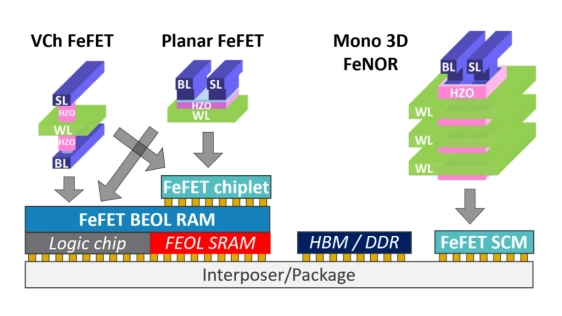
InGaZnO (IGZO)-channel FeFETs have attracted notable interest thanks to recent advances in endurance, opening up their application space for read-dominated AI memory tiers. This work evaluates the viability of NOR-type IGZO FeFETs for 3D heterogeneous AI memories from a read-centric design-technology co-optimization (DTCO) perspective, spanning on-chip back-end-of-line (BEOL) RAMs and hybrid-bonded memory chiplets, and off-chip, monolithically integrated 3D FeNOR storage-class memories (SCMs). For on-chip BEOL RAMs and memory chiplets, we demonstrate the cross-node bitcell footprint scalability of IGZO FeFETs capable of delivering down to 10-A SRAM-equivalent bitcell area (∼0.016 µm2) with 7-nm ground rules while maintaining a sub-5 ns random access latency -- despite their writability challenges. We further identify the sensing margin penalty in NOR FeFET arrays arising from sneak current associated with the negative program-state Vt, which requires positive-Vt engineering in order to eliminate the unwanted negative voltage read inhibition -- for example, by ferroelectric layer thinning. Last but not least, we elucidate the read margin implications on 3D FeNOR for SCMs, with the 3D stacking density limited by additional sneak current from neighbor channel shunting.
Index Terms: NOR FeFET, DTCO, BEOL RAM, Memory Chiplet, Storage Class Memory (SCM).
To read the full article, click here
Related Chiplet
- Optical Chiplet
- Reverse Gearbox Chiplet
- FlexGen Multi-Die Smart Network-on-Chip (NoC) IP
- Ncore Multi-Die Interconnect IP
- Integrated voltage regulator (IVR) chiplet
Related Technical Papers
- ThAME: 3D Memory-Enabled Heterogeneous Accelerator for LLM Mixture of Experts
- Exploring the Efficiency of 3D-Stacked AI Chip Architecture for LLM Inference with Voxel
- Co-Optimization of Power Delivery Network Design for 3-D Heterogeneous Integration of RRAM-Based Compute In-Memory Accelerators
- A3D-MoE: Acceleration of Large Language Models with Mixture of Experts via 3D Heterogeneous Integration
Latest Technical Papers
- Adaptive 3D Chiplet Architecture with Hybrid Wired–Wireless Interconnect for Energy-Efficient Heterogeneous Computing
- LLM-Augmented Bayesian Optimization with Adaptive Policies for Chiplet Design Space Exploration
- Divide and conquer: Scalable performance and energy in MCM GPUs
- A Composable AI-Accelerated Iterative Solver for 3D-IC Thermal Modeling
- QBX: A Compiler for 2-local Qubit Hamiltonian Simulation on Quantum Chiplets