Architecting the Next Generation of Asynchronous, Distributed GPUs for the AI Era
By Junrui Pan, Weili An, Cesar Avalos Baddouh, Christin David Bose, Ni Kang, Aaron Barnes, Ahmad Alawneh, Fangjia Shen, Yechen Liu, Anusuya Nallathambi, Atthin Chandrashekar, Timothy G. Rogers
Purdue University, West Lafayette, IN, USA
Abstract
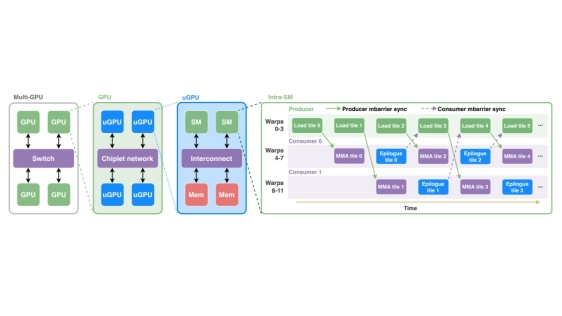
The rapid evolution of machine learning workloads has fundamentally transformed GPU hardware, driving architectures toward Multi-Chip Module (MCM) topologies, asynchronous execution primitives, and persistent, multi-phase kernel behaviors. Despite these shifts, cycle-level simulation infrastructure has lagged behind, lacking the native capability to model the physical non-uniformity of modern GPUs alongside the massive scale of state-of-the-art AI workloads. To bridge this gap, we present a cycle-level simulation framework designed to accurately model modern GPU generations, including Ampere, Hopper, and Blackwell. Rigorously validated against physical silicon, the simulator achieves a 99% Pearson correlation coefficient and a 13.4% mean absolute cycle error on the H100 GPU. Utilizing this infrastructure, we conduct architectural case studies to evaluate emerging design trajectories, including chiplet topology scaling, expanded SRAM capacity and bandwidth, and inter-GPU prefetching strategies.
To read the full article, click here
Related Chiplet
- FlexGen Multi-Die Smart Network-on-Chip (NoC) IP
- Ncore Multi-Die Interconnect IP
- Integrated voltage regulator (IVR) chiplet
- High-performance connectivity chiplets
- eFPGA Chiplet
Related Technical Papers
- Exploring the Efficiency of 3D-Stacked AI Chip Architecture for LLM Inference with Voxel
- The Next Frontier in Semiconductor Innovation: Chiplets and the Rise of 3D-ICs
- Securing the new chiplet era of semiconductor design
- Probing the Nanoscale Onset of Plasticity in Electroplated Copper for Hybrid Bonding Structures via Multimodal Atomic Force Microscopy
Latest Technical Papers
- Divide and conquer: Scalable performance and energy in MCM GPUs
- A Composable AI-Accelerated Iterative Solver for 3D-IC Thermal Modeling
- QBX: A Compiler for 2-local Qubit Hamiltonian Simulation on Quantum Chiplets
- U-Can-Inject-Errors (UCIe): A Protocol-Aware Hardware Trojan for FPGA Chiplet Links
- The Power of Indirection: Scaling Switches Beyond Silicon Boundaries