TSMC SoIC roadmap targets 2029 chip stacking
By Brian Tristam Williams, eeNews Europe | April 29, 2026
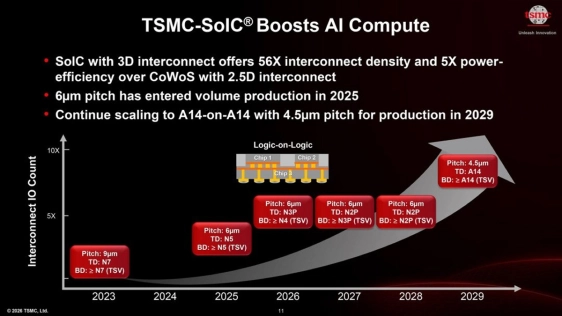
TSMC is pushing its 3D chip-stacking roadmap towards finer interconnect pitches and tighter integration as advanced packaging becomes a larger part of performance scaling for AI and high-performance computing designs.
The updated TSMC SoIC roadmap, reported after the company’s 2026 North America Technology Symposium in Santa Clara, points from 6 µm pitches today towards 4.5 µm by 2029. That direction matters because pitch scaling in hybrid-bonded die stacks directly affects the number of vertical interconnects that can be placed between chiplets.
TSMC separately said at its 2026 North America Technology Symposium that A14-to-A14 SoIC is set to be available for production in 2029, providing 1.8x higher die-to-die I/O density than N2-on-N2 SoIC. The company positions the technology as part of its wider 3DFabric advanced packaging family, alongside CoWoS and InFO.
To read the full article, click here
Related Chiplet
- FlexGen Multi-Die Smart Network-on-Chip (NoC) IP
- Ncore Multi-Die Interconnect IP
- Integrated voltage regulator (IVR) chiplet
- High-performance connectivity chiplets
- eFPGA Chiplet
Related News
- Optimizing Wafer Edge Processes For Chip Stacking
- Synopsys and TSMC Pave the Path for Trillion-Transistor AI and Multi-Die Chip Design
- Cadence and TSMC Advance AI and 3D-IC Chip Design with Certified Design Solutions for TSMC’s A16 and N2P Process Technologies
- CEA-Leti Pushes Stacking Roadmap as AI Runs Into Memory and Power Limits
Latest News
- Arteris Accelerates Industry Transition to Multi-Die Chiplet-Based Architecture
- Fujitsu launches made-in-Japan next-generation CPU FUJITSU-MONAKA and Fujitsu MONAKA Server for sovereign AI infrastructure
- Signaloid joins Open Chiplet Atlas Alliance and Announces Plans to Make Its UxHw ASICs Available via OCA Ecosystem
- Lorentz Solution Jointly Presents with NVIDIA on Automated Large-Scale Chip-Level 3D EM Extraction and Sign-off of Ultra-High-Speed Silicon Photonics and IC/3DIC Designs at 2026 TSMC OIP
- Alchip Technologies Showcases Advanced ASIC Design and Packaging at AI Infra Summit 2026