The keeper of Moore’s Law
By Nick Flaherty, eeNews Europe (December 14, 2024)
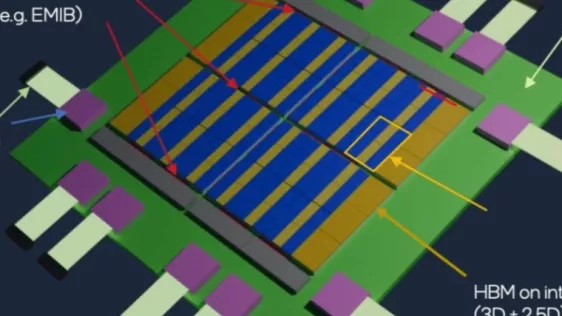
IEDM is always eye opening for the advances of device technology. The 2024 meeting in San Francisco this week has not only shown the latest 2nm CMOS process technologies, but way beyond.
TSMC is discussing the technology for its A16 node at the end of 2026, while European researchers at imec have been showing, and making, the components for a standard cell with stacked CFET nanosheet transistors for A7 in the early 2030s.
While there used to be talk of the ‘end of Moore’s Law’ (and certainly the end of Dennard scaling) Intel has been pushing back.
“We continue to be the stewards of Moore’s Law for the industry,” said Sanjay Natarajan, SVP & GM of the Intel Technology Research Group, the newly renamed Components Research group. “We are releasing groundbreaking new technology,” he said. “We have in my opinion perhaps the strongest research development pipeline in the industry.”
He points to the combination of device technology, interconnect and packaging as vital to driving the technology forward.
To read the full article, click here
Related Chiplet
- Optical Chiplet
- Reverse Gearbox Chiplet
- FlexGen Multi-Die Smart Network-on-Chip (NoC) IP
- Ncore Multi-Die Interconnect IP
- Integrated voltage regulator (IVR) chiplet
Related News
- Inside The World Of Advanced Packaging
- Fraunhofer IZM is powering the evolution of chiplet technologies as part of the APECS pilot line
- Xallent and MPI Announce Strategic Partnership to Innovate and Accelerate the Development of Next Generation AI Chips
- Arm Chiplet System Architecture Makes New Strides in Accelerating the Evolution of Silicon
Latest News
- Tenstorrent Releases Open Source Beta of the Open Chiplet Atlas® (OCA) Harness
- Building Out Advanced Packaging Portfolio, JCET Delivers Steady Revenue Growth and Improved Profitability in Q3 YTD 2026
- Egis Group and SiPearl Sign Strategic Cooperation and Investment Agreements to Expand Opportunities on a Global Scale
- Unigen Expands AI Module and Server Compute Collaboration to EdgeCortix RAIDEN Platform
- Amkor Technology and NVIDIA Advance Strategic Partnership for AI Infrastructure