Chiplet Architectures as a Practical Path to Scalable Automotive Compute

The automotive industry is reshaping vehicle electronics around centralized and zonal compute architectures. Distributed electronic control units are giving way to powerful central processors capable of running infotainment, advanced driver assistance, gateway, and vehicle control workloads on a shared platform. This transition enables software‑defined vehicles (SDVs), supports advanced safety functions, and allows manufacturers to reuse software across multiple vehicle generations.
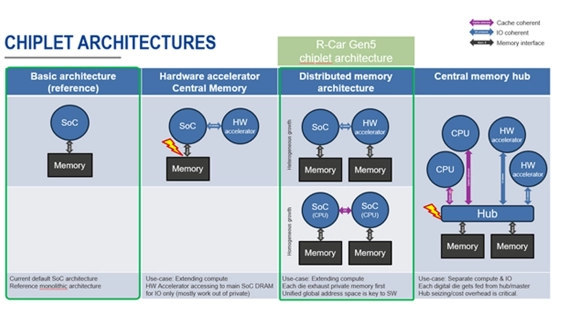 At the same time, it exposes a fundamental challenge: Compute requirements are growing far faster than conventional system‑on‑chip (SoC) scaling can accommodate. Increased AI workloads, higher‑resolution sensor processing, and domain convergence demand orders of magnitude more performance, while automotive constraints on power, cost, and reliability remain unchanged.
Chiplet architectures have emerged as one of the most viable ways to reconcile these conflicting trends. By decomposing large SoCs into multiple dies integrated within a single package, chiplets offer a scalable alternative to increasingly impractical monolithic designs. In automotive systems, however, chiplets only succeed when they address cost efficiency, deterministic performance, and long‑term software stability simultaneously.
To read the full article, click here
Related Chiplet
- Optical Chiplet
- Reverse Gearbox Chiplet
- FlexGen Multi-Die Smart Network-on-Chip (NoC) IP
- Ncore Multi-Die Interconnect IP
- Integrated voltage regulator (IVR) chiplet
Related Blogs
- Marvell Joins Imec Automotive Chiplet Initiative to Facilitate Compute SoCs for Super-human Sensing
- Advancing Europe’s Automotive Chiplet Vision: Arteris Joins CHASSIS to Accelerate Software-Defined Mobility
- From horsepower to high-performance compute: automotive chiplets take the leap towards autonomous edge computing
- Arm Ecosystem Collaborates on Standards to Enable a Thriving Chiplet Market