From Chiplet Design to Physical Reality: Why AI Hardware Needs Continuous Engineering Intelligence

AI hardware is becoming increasingly modular.
Compute dies, HBM stacks, I/O chiplets, optical engines, accelerators, interposers, RDL, substrates, and increasingly complex thermal structures are being combined into systems whose capabilities would be difficult to achieve efficiently with a single monolithic die.
This transition is enabling extraordinary performance.
It is also changing the engineering problem.
A chiplet system begins as design intent. Models predict how electrical, thermal, mechanical, optical, and power-delivery domains should behave. EDA tools help optimize those domains. Manufacturing then converts the design into physical hardware.
But the manufactured product is never a perfect copy of the digital model.
Materials vary.
Interfaces vary.
Placement and alignment vary.
Interconnect geometry moves within process tolerances.
Assembly introduces stress.
Temperature changes electrical and mechanical behavior.
Aging changes the physical system over time.
A high-speed die-to-die interface may meet its nominal impedance target while local geometry, material behavior, thermal gradients, assembly variation, or interconnect aging move the actual physical state away from what was originally predicted.
This creates a fundamental challenge for the next generation of AI hardware:
How do we keep what was designed, what was manufactured, what was measured, and what the system ultimately experiences connected to the same physical product?
That question extends chiplet engineering well beyond design signoff.
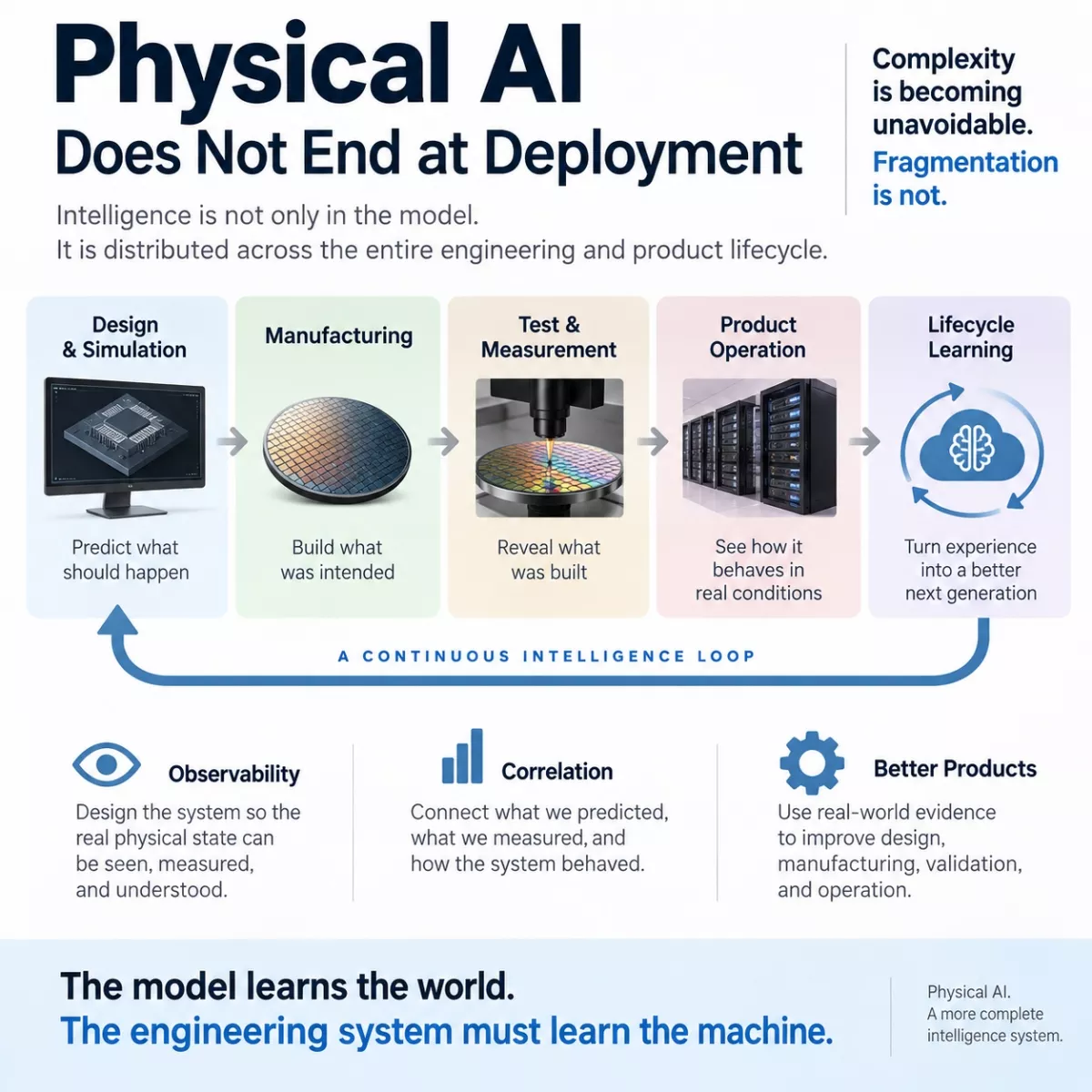
The Physical Product Does Not End at the Digital Model
The traditional development picture can appear relatively simple:
Design → Manufacture → Test → Deploy
For highly heterogeneous AI hardware, that view is increasingly incomplete.
A more realistic path is:
Intent → Prediction → Physical Architecture → Manufacturing State → Inspection / Metrology / Test → Measurement → Evidence → Correlation → Functional Behavior → Reliability / Yield → Field Experience → Learning
Every transition can introduce divergence.
A simulation may accurately describe the nominal design but not the complete distribution of manufacturing variation.
A package may pass initial functional test while containing an interface condition that later becomes a reliability problem.
A component may qualify individually while system integration introduces a new electrical, thermal, or mechanical interaction.
A field event may expose a mechanism that was not visible during either design verification or manufacturing qualification.
For chiplet systems, this becomes especially important because the product crosses so many physical boundaries.
The final system is not defined by silicon alone.
It is defined by the behavior of the integrated physical structure.
Observability Has to Move Upstream
This is where observability becomes an architectural issue.
Observability is an architectural capability that makes meaningful evidence possible later.
Observability is not measurement.
It is the ability designed into a system to make an important physical state accessible, inferable, or distinguishable once the hardware exists.
In advanced chiplet systems, engineers may eventually need to understand:
- the state of a die-to-die link,
- a buried bonding interface,
- local temperature or strain,
- alignment,
- current distribution,
- timing margin,
- material degradation,
- interconnect aging,
- or another physical variable that influences product behavior.
If the architecture never made that physical state observable, downstream analytics cannot completely recover what was never accessible in the first place.
That changes the design question.
It is no longer enough to ask:
Can we build this architecture?
We increasingly also need to ask:
Will the architecture allow us to generate the evidence needed to understand what we built?
That is particularly important as hybrid bonding, HBM, advanced substrates, optical interfaces, and dense 3D structures make more of the product physically inaccessible after integration.
Measurement Is Not Yet Evidence
Once hardware exists, inspection, metrology, functional test, embedded monitors, and telemetry can acquire observations.
But observations alone do not create engineering understanding.
An X-ray image is an observation.
A waveform is an observation.
A temperature measurement is an observation.
A resistance shift is an observation.
A telemetry signature is an observation.
Those observations become meaningful engineering evidence only when they remain connected to the correct physical context:
design revision → physical structure → material state → process history → equipment conditions → operating condition → measurement uncertainty → product requirement
That distinction matters.
A complex AI package can generate enormous quantities of data while engineers still remain uncertain about why the system behaved the way it did.
The objective is therefore not simply more measurement.
It is meaningful, traceable evidence.
Correlation Connects Prediction to Physical Reality
Evidence is still not the final step.
The next challenge is correlation.
Correlation asks whether:
what we predicted
are consistent with one another.
Consider a high-speed die-to-die interface that develops unexpected margin loss.
Electrical test may reveal the symptom.
Metrology may identify geometry variation.
Thermal measurements may show a local gradient.
Manufacturing history may expose a process shift.
DOE may identify sensitivity to one variable—or to an interaction between several variables.
Reliability testing may then reveal how that physical condition evolves with time and stress.
Each discipline sees a different piece.
The engineering understanding emerges when those pieces are connected.
That is why DOE remains so valuable.
Without DOE, manufacturing variation is observed. With DOE, variation can become causal engineering knowledge.
Controlled variation helps reveal which parameters actually influence the structure, how variables interact, where the process window exists, and which conditions require tighter control.
Correlation tells us what moved.
DOE and causal investigation help explain why.
AI Hardware Needs Intelligence Around the Product, Not Only Inside It
AI hardware already contains enormous intelligence inside the product.
But increasingly complex heterogeneous systems create another need.
The engineering system itself needs continuous engineering intelligence.
By this I mean:
A capability that keeps design intent, physical state, manufacturing history, measured evidence, reliability, yield, and field learning connected across the product lifecycle.
This is not simply more generative AI.
It is not simply more simulation.
It is not simply more telemetry.
And it is not another isolated optimization tool.
Its value comes from maintaining continuity across the engineering lifecycle so that learning in one domain can influence decisions in the others.
A yield excursion should be able to point engineers back toward physical geometry, process history, materials, equipment conditions, and design assumptions.
A reliability failure should influence future inspection strategy and DOE.
A measured electrical or thermal signature should improve the next physical model.
Field behavior should inform not only software updates, but future package architecture, materials selection, manufacturing controls, and validation strategy.
That creates a broader learning loop:
Engineering → Physical Implementation → Measurement → Product Operation → Learning → Engineering
The product becomes a source of engineering knowledge throughout its lifecycle.
Complexity Is Becoming Unavoidable. Fragmentation Is Not.
One response to multi-die complexity is to avoid it whenever possible.
For some products, that may be completely appropriate.
But frontier AI infrastructure is moving in the opposite direction.
HBM, chiplets, advanced packaging, optical I/O, high-density power delivery, sophisticated thermal management, and increasingly complex interconnect structures are becoming central to continued system scaling.
The engineering challenge is therefore not simply how to avoid heterogeneous complexity.
It is how to manage that complexity without allowing the engineering process itself to fragment.
The industry already has extraordinary capabilities in:
design, simulation, materials, equipment, manufacturing, inspection, metrology, test, reliability, and yield.
The gap increasingly lies between them.
A chiplet product is not complete because each discipline independently reports success.
It becomes a product when the evidence from those disciplines converges strongly enough around the same physical system to support repeatable behavior.
That is the larger opportunity for continuous engineering intelligence.
Physical AI Has Two Intelligence Problems
Physical AI is often discussed in terms of machines understanding and acting within the physical world.
That remains essential.
But AI hardware introduces another intelligence problem.
The machine must understand its environment.
The engineering system must continuously understand the machine.
The first concerns intelligence inside the product.
The second concerns intelligence across the product lifecycle.
Both depend on physical reality.
The long-term opportunity is therefore larger than designing more intelligent chips.
It is creating an engineering system capable of preserving continuity between:
- what we intended,
- what we predicted,
- what we manufactured,
- what we measured,
- what happened,
- and what we learn next.
That is how increasingly complex chiplet architectures can move from impressive designs to repeatable products.
Physical AI teaches the machine to understand its environment. Continuous engineering intelligence helps us continuously understand the physical machine.
For the next generation of AI hardware, that second challenge may become just as important as the first.
© 2026 Moh Kolbehdari. Original technical perspective. All rights reserved.
Related Chiplet
- Optical Chiplet
- Reverse Gearbox Chiplet
- FlexGen Multi-Die Smart Network-on-Chip (NoC) IP
- Ncore Multi-Die Interconnect IP
- Integrated voltage regulator (IVR) chiplet
Related Blogs
- From Spec to Silicon: Successful Physical AI System Chiplet Bring-Up
- Alphawave Semi Bridges from Theory to Reality in Chiplet-Based AI
- Cadence Commits to Join imec Automotive Chiplet Programme
- Cadence and AVCC to Advance Physical AI Innovations for Autonomous Vehicles
Latest Blogs
- The AI Packaging Challenge: 5 Reasons Panels Are Gaining Momentum
- Understanding the Shift Towards Chiplet Architecture in SoC Design
- Cooling Is Becoming Part of the Chiplet Architecture
- When AI Moves the World: Building a Chiplet Standard for Physical AI
- Co-Packaged Optics Moves from Promise to Production Planning