Chiplets: Making the Pieces Work Together

Chiplet architectures promise speed and flexibility, but as systems scale, latency, bandwidth efficiency, and coherence determine real performance.
 If you ask most engineers what makes chiplets hard, the first answer is usually packaging: interposers vs. organic substrates, thermal paths, bump pitch, signal integrity, yield, and assembly. Those topics matter, but they’re no longer the full story.
The deeper shift is architectural. Chiplets turn a “single-die computer” into a distributed system in a package. And as distributed systems have taught us for decades, performance is rarely limited by raw compute alone. It’s limited by communication: the latency of moving data, the availability of bandwidth, and the cost of maintaining a consistent view of memory across many participants (see USENIX’s chiplet network scaling paper).
Packaging Enables Chiplets — Interconnect Determines Whether They Behave Like One System
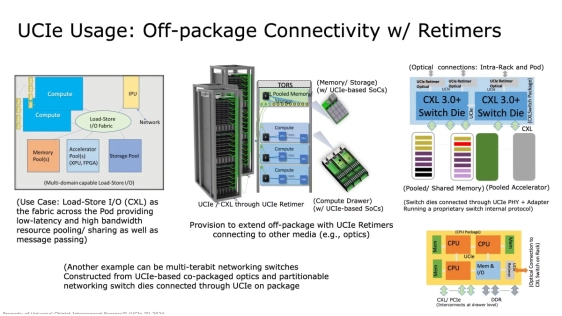
Chiplets exist because the industry needs new ways to scale beyond the practical limits of monolithic dies — reticle limits, yield constraints, and the desire to mix process nodes and functions. Modern die-to-die standards reflect that motivation explicitly. The UCIe Consortium describes UCIe as a package-level die-to-die interconnect standard that spans physical layer, protocols, and software/compliance, aiming to make multi-vendor chiplet composition feasible (see UCIe Consortium’s specifications).
To read the full article, click here
Related Chiplet
- Optical Chiplet
- Reverse Gearbox Chiplet
- FlexGen Multi-Die Smart Network-on-Chip (NoC) IP
- Ncore Multi-Die Interconnect IP
- Integrated voltage regulator (IVR) chiplet
Related Blogs
- Making chiplets work for AI requires more than connectivity
- Four Reasons Chiplets Will Take Over the World (and why it hasn’t happened yet)
- Scaling AI Data Centers: The Role of Chiplets and Connectivity
- The Age of Chiplets is Upon Us