AI Chiplets Will Not Age Together: Why Heterogeneous Integration Must Become Lifetime-Aware

Why Heterogeneous Integration Must Become Lifetime-Aware
The industry has spent several years learning how to divide large systems into chiplets.
The next challenge may be harder:
How do we manage a system when those chiplets do not age at the same rate?
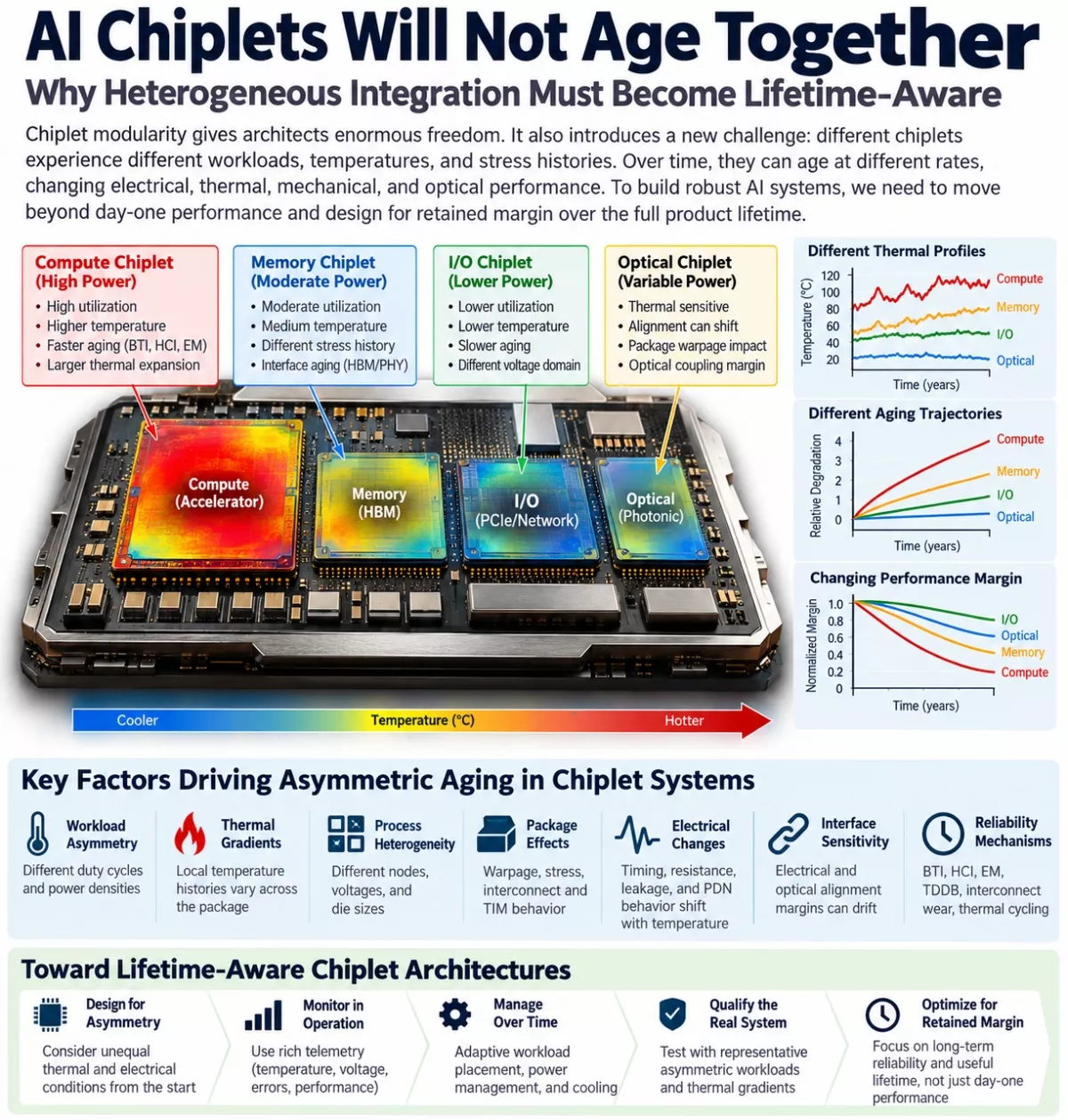
A heterogeneous AI package can combine compute chiplets, I/O die, HBM interfaces, SerDes, network functions, cache, accelerators, and increasingly optical components. These elements do not operate under identical electrical or thermal conditions. They experience different workloads, different power densities, different temperatures, and different duty cycles.
At the beginning of life, that asymmetry may look like an implementation detail.
Over time, it can become an architecture problem.
A compute chiplet running sustained matrix operations may spend much of its life near a high-power operating point. An I/O chiplet next to it may operate at a much lower average power. A SerDes region can experience its own localized activity and thermal behavior. Memory interfaces, optical engines, and power-delivery structures each see different stress histories.
The result is simple but important:
A heterogeneous package does not have one aging trajectory. It has several.
Day-One Performance Is Not Enough
Most architecture discussions understandably begin with nominal requirements:
- bandwidth,
- latency,
- power,
- interconnect reach,
- thermal design power,
- package size,
- and cost.
These determine whether the system can be built.
But qualification and long-term product behavior introduce a second question:
Will all of the critical parts of the system retain sufficient margin after years of unequal electrical and thermal stress?
Silicon aging is influenced by mechanisms such as bias-temperature instability, hot-carrier effects, electromigration, dielectric degradation, and interconnect wear. Temperature strongly influences many of these mechanisms.
The key issue in a chiplet system is that the relevant temperature is not simply the package temperature.
It is the local thermal history of each function.
Two chiplets in the same package can therefore begin life with similar electrical margins and reach very different states later.
That creates a new type of heterogeneity:
lifetime heterogeneity.
Thermal Asymmetry Becomes Electrical Asymmetry
Temperature affects more than reliability.
It also changes electrical behavior.
As local temperature changes, transistor performance, interconnect resistance, leakage, timing margin, and power-delivery behavior can shift. Local heating can therefore create a feedback loop:
workload → power → temperature → electrical behavior → aging → changed performance margin
In a monolithic device, those effects are already difficult to manage.
In a chiplet architecture, each die can follow a different version of that loop.
That means the package may gradually move away from the balanced operating condition assumed during nominal design.
A system that began as:
Compute A = Compute B
may eventually behave more like:
Compute A ≠ Compute B
even if the two chiplets were originally identical.
Now add heterogeneous functions, different process technologies, different die sizes, different voltage domains, different cooling proximity, and different package locations.
The problem becomes substantially more complex.
This Is Not Just a Silicon Problem
One of the mistakes we should avoid is treating this purely as transistor aging.
The physical package participates in the same evolution.
Temperature gradients can change:
- package warpage,
- local stress,
- interconnect resistance,
- bump and bond conditions,
- interface geometry,
- TIM behavior,
- and optical alignment.
The electrical, mechanical, and thermal states therefore evolve together.
Consider a package containing a high-power accelerator next to a cooler I/O die.
The hotter region experiences a different thermal expansion state.
That can change local package geometry.
Geometry changes can alter electrical and optical interfaces.
Those interfaces then see different performance margins than the nominal design predicted.
This is why heterogeneous integration increasingly requires us to think beyond component reliability.
The relevant question is:
How does the complete realized system evolve under asymmetric use?
Binning Alone Will Not Solve It
One possible response is tighter binning.
Chiplets can be characterized for leakage, power, frequency, thermal behavior, or other parameters and then matched during assembly.
That can help.
But binning solves primarily an initial-condition problem.
It does not guarantee that two matched chiplets will remain matched after years of different workloads.
A compute die that spends thousands of hours at high utilization and a neighboring I/O die operating at modest duty cycle will accumulate different stress even if they were perfectly matched on the production tester.
The architecture therefore needs something beyond static manufacturing selection.
It needs lifetime awareness.
The Package May Need Its Own Runtime Feedback Loop
This is where AI infrastructure becomes particularly interesting.
Modern systems already contain extensive telemetry:
- temperature sensors,
- voltage monitors,
- current monitors,
- error counters,
- performance monitors,
- link-health information,
- and workload telemetry.
Today, much of that data is used for protection, cooling control, or performance management.
In the future, it may also become part of lifetime management.
Imagine a system that knows:
- which accelerator has accumulated the greatest thermal exposure,
- which chiplet has experienced the largest voltage stress,
- which interconnect is losing margin,
- which region is experiencing repeated thermal cycling,
- and which optical or electrical interface is gradually moving toward its tolerance boundary.
The scheduler could then use that information.
Workloads might be redistributed.
Voltage and frequency could be adjusted.
Cooling resources could be redirected.
Redundant resources could be rotated.
Aging could become another state variable in system optimization.
This would extend the chiplet concept beyond modular hardware.
It would make the system adaptive over its lifetime.
From Design Margin to Retained Margin
This also changes how we should think about margin.
A conventional design question asks:
How much margin does the system have at nominal conditions?
A more useful heterogeneous-integration question is:
How much margin remains after manufacturing variation, thermal history, workload asymmetry, and aging have acted on the physical system?
That is retained margin.
The distinction matters because a design with exceptional initial performance may not be the most robust architecture.
An alternative architecture with slightly lower nominal performance but lower thermal sensitivity, better observability, or greater tolerance to aging may deliver more useful margin over product life.
This is especially important for expensive AI infrastructure, where the useful operating lifetime of the platform matters economically as much as its day-one benchmark.
Qualification Must Become More Representative
Traditional reliability testing remains essential.
But highly heterogeneous systems may require qualification strategies that better represent asymmetric operation.
A package should not only experience uniform temperature and uniform stress.
It may need scenarios where:
- one chiplet operates at sustained high power,
- neighboring die remain relatively cool,
- workload moves dynamically,
- localized thermal gradients develop,
- and electrical and optical interfaces are monitored while the package deforms.
The goal is not merely to prove that each component survives.
The goal is to understand whether the system remains balanced enough to meet its product requirements.
That requires correlation across:
silicon telemetry → package temperature → physical geometry → electrical behavior → optical behavior → reliability
The package becomes the physical link connecting these domains.
Chiplet Modularity Is Becoming Temporal
Chiplets are usually discussed in spatial terms.
We divide functions physically:
compute here, memory there, I/O somewhere else.
But the next stage of modularity may also be temporal.
Different modules will age differently.
Different parts of the package will move through their reliability envelopes at different speeds.
The architecture will need to know that.
This suggests an important evolution:
chiplet architecture → chiplet realization → chiplet lifetime management
The winning systems may not simply be those that integrate the most chiplets or provide the highest nominal bandwidth.
They may be the systems that can observe, understand, and manage their own physical evolution.
Conclusion
Heterogeneous integration gives architects enormous freedom.
It also removes one assumption that was easier to make in simpler systems:
that the hardware will age approximately together.
In advanced AI packages, it may not.
Compute, memory, I/O, interconnect, and optical functions can experience very different power and thermal histories. Those differences affect silicon aging, package deformation, electrical behavior, and interface margin.
The architecture therefore has to consider not only where functions are placed, but how their physical states evolve over time.
The next generation of chiplet systems may need to become lifetime-aware.
Because in heterogeneous AI infrastructure:
The chiplets may start together. They will not necessarily age together.
© 2026 Moh Kolbehdari. All rights reserved.
Original article and figure by Moh Kolbehdari.
Related Chiplet
- FlexGen Multi-Die Smart Network-on-Chip (NoC) IP
- Ncore Multi-Die Interconnect IP
- Integrated voltage regulator (IVR) chiplet
- High-performance connectivity chiplets
- eFPGA Chiplet
Related Blogs
- How Disruptive will Chiplets be for Intel and TSMC?
- The Need for Chiplets, and UCIe in Automotive
- Four Reasons Chiplets Will Take Over the World (and why it hasn’t happened yet)
- Scaling AI Data Centers: The Role of Chiplets and Connectivity
Latest Blogs
- Deep dive into Azure Maia 300 architecture
- AI Chiplets Will Not Age Together: Why Heterogeneous Integration Must Become Lifetime-Aware
- UCIe 3.0: Faster Links Are Only Half the Story
- Chiplet Modularity Is Becoming Part of the AI Architecture
- Hierarchies Of Interconnects Are As Important As Compute And Memory