Nvidia, TSMC, and advanced packaging realignment in 2025
By Majeed Ahmad, EDN (January 20, 2025)
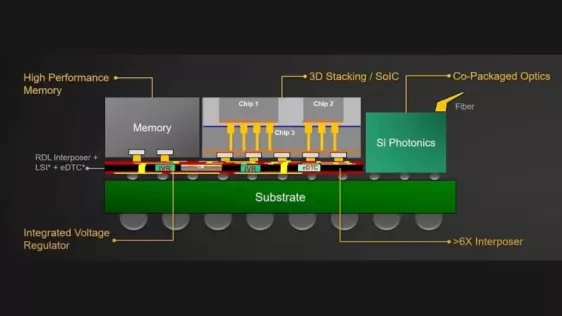
Nvidia’s CEO Jensen Huang has made waves by saying that his company’s most advanced artificial intelligence (AI) chip, Blackwell, will transition from CowoS-S to CoWoS-L advanced packaging technology. That also shows how TSMC’s advanced packaging technology—chip on wafer on substrate (CoWoS)—is evolving to overcome interconnect battles inside large, powerful chips for AI and other high-performance computing (HPC) applications.
The CoWoS-S advanced packaging technology uses a single silicon interposer and through-silicon vias (TSVs) to facilitate the direct transmission of high-speed electrical signals between the die and the substrate. However, single silicon interposers often confront yield issues.
To read the full article, click here
Related Chiplet
- Integrated voltage regulator (IVR) chiplet
- High-performance connectivity chiplets
- eFPGA Chiplet
- DPIQ Tx PICs
- IMDD Tx PICs
Related News
- Lorentz Solution Jointly Presents with NVIDIA on Large-Scale 3D Terahertz EM Simulation for Real IC/3DIC Silicon Case Studies in Photonic Switches at 2025 TSMC OIP
- JCET Accelerates Strategic Shift Toward High-End Advanced Packaging, 2025 Advanced Packaging Revenue Hits Record High
- IC-Link by imec joins TSMC 3DFabric® Alliance to accelerate advanced packaging and 3D IC innovation
- TSMC and Amkor Technology Announce Long Term Partnership to Accelerate Advanced Packaging in the United States
Latest News
- proteanTecs Unveils Advanced Packaging Solutions to Improve Yield, Performance, and Reliability of Multi-Die Systems
- JCET Advances High-Aspect-Ratio TSV Technology for 2.5D and 3D Packaging
- Semiconductor Research Corporation Launches SPARC, Accelerating Industry-Driven University Research for the Next Generation of Semiconductor Innovation
- The world’s first technology 'Silicon Motherboard' Circuits are formed on both sides of the silicon substrate, reducing mounting footprint by 80%
- Avicena Ships World's First 1Tbps Evaluation Kits, Extending Its Leadership in microLED Optical Interconnects