CEA-Leti Pushes Stacking Roadmap as AI Runs Into Memory and Power Limits
Pascal Vivet says AI systems need memory placed closer to compute, wider data paths, and earlier co-optimization.
By Pat Brans, EE Times | July 31, 2026
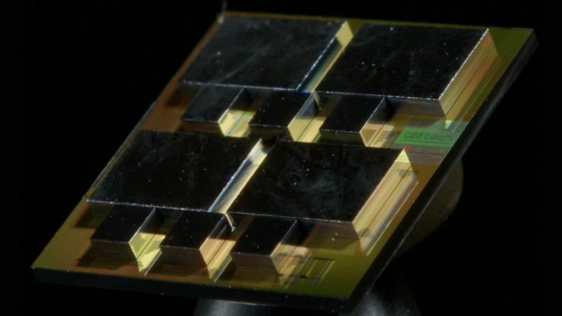
As AI models grow, hardware designers face a new challenge: placing far more memory closer to processors, moving data with less energy, and cooling systems whose power density keeps rising. For Pascal Vivet, program manager for advanced programs at CEA-Leti, that challenge is pushing 3D integration and chiplet-based architectures from advanced packaging technologies into the center of AI system design.
“3D technology is key,” Vivet told EE Times, because it allows the industry to scale “horizontally, vertically, and to assemble the best technology for chiplet partitioning in an open ecosystem.”
To read the full article, click here
Related Chiplet
- FlexGen Multi-Die Smart Network-on-Chip (NoC) IP
- Ncore Multi-Die Interconnect IP
- Integrated voltage regulator (IVR) chiplet
- High-performance connectivity chiplets
- eFPGA Chiplet
Related News
- Siemens launches Fuse EDA AI Agent for automation across semiconductor, 3D IC and PCB system workflows
- CEA-Leti, CEA-List and PSMC Collaborate to Integrate RISC-V and MicroLED Silicon Photonics into 3D Stacking and Interposer for Next-Generation AI
- TSMC Announces Breakthrough Set to Redefine the Future of 3D IC
- UMC Launches W2W 3D IC Project with Partners, Targeting Growth in Edge AI
Latest News
- Polaris Electro-Optics Secures $50M Series B to Scale Next-Gen Optical Engine Platform for AI Infrastructure
- Arteris Accelerates Industry Transition to Multi-Die Chiplet-Based Architecture
- Fujitsu launches made-in-Japan next-generation CPU FUJITSU-MONAKA and Fujitsu MONAKA Server for sovereign AI infrastructure
- Signaloid joins Open Chiplet Atlas Alliance and Announces Plans to Make Its UxHw ASICs Available via OCA Ecosystem
- Lorentz Solution Jointly Presents with NVIDIA on Automated Large-Scale Chip-Level 3D EM Extraction and Sign-off of Ultra-High-Speed Silicon Photonics and IC/3DIC Designs at 2026 TSMC OIP