AI Boom Drives Demand for Ultra-Large Packaging as ASICs Expected to Shift from CoWoS to EMIB, Says TrendForce
November 25, 2025 -- TrendForce’s latest investigations reveal that the rapid expansion of AI and HPC is increasing the need for heterogeneous integration, positioning advanced packaging as a strategic priority. TSMC’s CoWoS platform is currently the leading solution in this area. However, as CSPs accelerate their in-house ASIC development to accommodate more complex functions, their packaging size requirements are growing substantially. As a result, some CSPs are contemplating a switch from TSMC’s CoWoS to Intel’s EMIB.
TrendForce notes that CoWoS connects compute logic, memory, and I/O dies via an interposer, which mounts them on a substrate. The technology has expanded to include CoWoS-S, CoWoS-R, and CoWoS-L. Demand has been strongly shifting toward CoWoS-L, which incorporates a silicon interposer into the package, as NVIDIA’s Blackwell platform approaches mass production in 2025. This trend is expected to continue with NVIDIA’s upcoming Rubin architecture, which will boast even larger reticle sizes.
The rise in AI/HPC demand has led to significant CoWoS bottlenecks, including capacity shortages, reticle size restrictions, and elevated manufacturing costs. TrendForce observes that most CoWoS capacity is already taken by NVIDIA GPUs, leaving other clients with limited options. Furthermore, the increasing demand for larger package sizes and US localization requirements are encouraging major North American CSPs, like Google and Meta, to collaborate with Intel on EMIB adoption.
TSMC leads with technology, but Intel counters with size and cost advantages
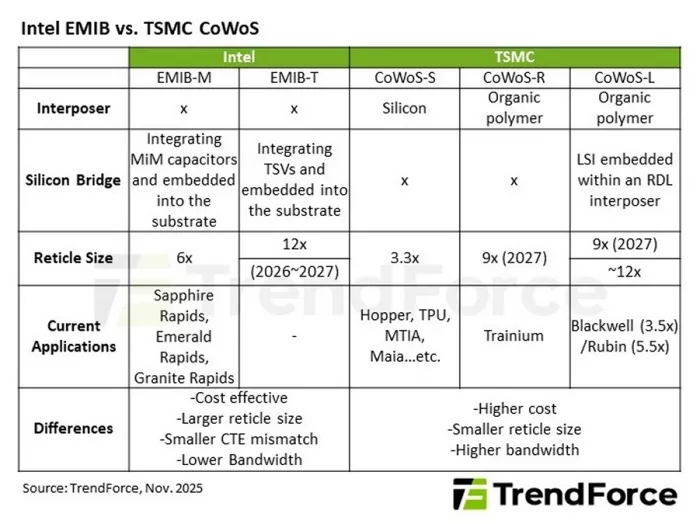
Intel’s EMIB provides several advantages over CoWoS. First, EMIB removes the necessity for a large, expensive interposer by integrating small silicon bridges directly into the substrate for die-to-die connections. This design simplifies the structure and enhances manufacturing yield. Second, EMIB minimizes thermal-expansion mismatches caused by materials with different CTEs, as only a small portion of the package contains silicon. This reduces the risk of warpage and boosts long-term reliability.
EMIB also enables larger effective reticle-size scaling: while CoWoS-S is limited to 3.3× and CoWoS-L is approximately 3.5× (projected to reach 9× by 2027), EMIB-M already supports 6× and is anticipated to achieve 8–12× by 2026–2027. Cost is another significant benefit—by eliminating the interposer, EMIB provides a more cost-effective solution for AI customers requiring very large packages.
However, EMIB has inherent limitations: the silicon bridge’s restricted area and routing density limit bandwidth, extend transmission distances, and cause slightly higher latency than CoWoS. Consequently, EMIB mainly attracts ASIC customers rather than GPU vendors, who demand very high bandwidth and very low latency.
According to TrendForce, since announcing the launch of its standalone Intel Foundry Services (IFS) unit in 2021, Intel has spent years developing EMIB advanced packaging technology. The company has successfully implemented this technology in its own server CPU platforms, including Sapphire Rapids and Granite Rapids. As Google plans to implement EMIB in its 2027 TPU v9 and Meta considers it for its MTIA accelerators, EMIB is set to significantly boost IFS's growth. Nonetheless, for the near future, CoWoS will continue to be the primary solution for high-bandwidth products from NVIDIA and AMD.
For more information on reports and market data from TrendForce’s Department of Semiconductor Research, please click here, or email the Sales Department at SR_MI@trendforce.com
Related Chiplet
- Optical Chiplet
- Reverse Gearbox Chiplet
- FlexGen Multi-Die Smart Network-on-Chip (NoC) IP
- Ncore Multi-Die Interconnect IP
- Integrated voltage regulator (IVR) chiplet
Related News
- AI Chip Packaging Pushes Beyond Reticle Limits, with CoWoS-L Set to Remain the Mainstream Advanced Packaging Solution Through 2028
- Chiplet Summit 2026 to Spotlight AI Acceleration and Advanced Packaging
- Onto Innovation’s Dragonfly® G5 System Qualified for Applications in 2.5D AI Packaging
- AI Competition Turns into a Supply Chain Arms Race, Tightening Advanced Packaging and 3nm Capacity
Latest News
- Wiwynn, Ayar Labs, and GUC Advance Co-Packaged Optics with Live Demonstration of Integrated Optical Compute System at OCP Global Summit 2026
- ForwardEdge ASIC Announces UCIe 3.0 IP Solution to Accelerate Next-Generation Chiplet-Based ASIC Innovation
- Eliyan Introduces NuLight™: World’s First 2D microVCSEL Interconnect Solution to the Copper Wall
- Evatec delivers first CLUSTERLINE® 310 for Advanced Packaging on small panel formats
- Europe’s Advanced Packaging Gap: Fraunhofer, Swissbit Target the Missing Middle