How AI is driving a new paradigm in test distribution

Artificial intelligence (AI) is accelerating semiconductor innovation at a pace that is forcing a rethinking of conventional production test strategies. The rapid scaling of graphics processing units (GPUs), AI accelerators, and heterogeneous compute architectures is increasing not only device complexity, but also the amount of test content required to validate performance, reliability, and quality across the manufacturing flow.
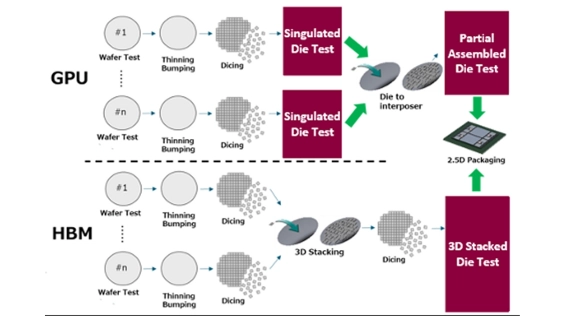 As AI infrastructure investments continue to expand, semiconductor manufacturers are building increasingly sophisticated devices that combine massive transistor counts, advanced packaging, high-bandwidth memory (HBM), chiplet architectures, and emerging co-packaged optical (CPO) interfaces. These devices are redefining the relationship between design, validation, and production test.
The result is a new test paradigm in which test content, infrastructure, and analytics are distributed dynamically across multiple insertions—from wafer sort through system-level test (SLT)—to balance cost-of-test, defective-parts-per-million (DPPM), and time-to-market objectives.
To read the full article, click here
Related Chiplet
- Optical Chiplet
- Reverse Gearbox Chiplet
- FlexGen Multi-Die Smart Network-on-Chip (NoC) IP
- Ncore Multi-Die Interconnect IP
- Integrated voltage regulator (IVR) chiplet
Related Blogs
- Beyond the Die Boundary: How Arteris Multi-Die Technology Is Redefining AI System Design
- Podcast: How Achronix is Enabling Multi-Die Design and a Chiplet Ecosystem with Nick Ilyadis
- 3D ICs, Chiplets & HBM: How Packaging Is Driving the Semiconductor Roadmap
- Inside the Chiplet Revolution: How Arm’s Compute Subsystems Platform is Democratizing Custom AI Silicon