Siemens expands agentic AI collaboration to tackle 3D IC power and thermal challenges with NVIDIA
- Builds on agentic AI capabilities introduced at DAC 2026, extending them to 3D integrated circuits (3D IC) electrothermal codesign
- Orchestrates nine automated workflow stages across seven of Siemens’ electronic design automation (EDA) tools, reducing setup effort by up to 95 percent
- Enables evaluation of up to 50x as many design alternatives to address power and thermal constraints in advanced 3D IC packages for AI computing
- Part of an expanding portfolio of long-running, self-verifying agentic AI workflows across the EDA design flow
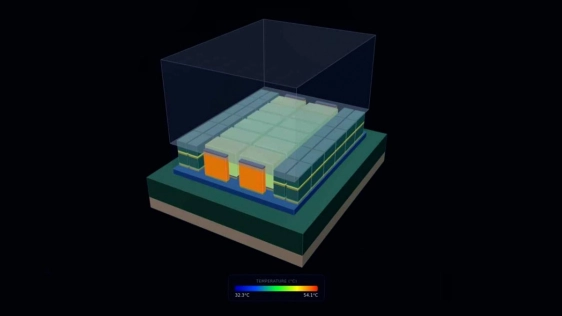 Plano, Texas, USA – October 21, 2026 – Siemens today announced an expansion of its EDA agentic AI portfolio, developed in collaboration with NVIDIA. The latest updates combine the self-verifying agentic AI capabilities introduced at DAC 2026 with NVIDIA accelerated computing to address one of advanced packaging's most demanding hurdles: electrical, power, thermal and codesign for 3D ICs.
The new capability orchestrates Siemens’ electrothermal analysis portfolio into a single autonomous workflow. By leveraging Siemens’ Design Space Exploration and Optimization (DSE/DSO) technology, the workflow allows engineers to evaluate and validate hundreds of design alternatives against signoff-grade, physics-based solvers. In benchmark studies, this approach reduced engineering effort by up to 95 percent (reducing a multi-week process to a matter of hours), cut workflow setup time by up to 99 percent (typically, less than five minutes versus several days across seven tools) and enabled up to 50x greater design exploration coverage compared to conventional manual flows.
"Electrothermal codesign has traditionally required experts to coordinate multiple tools and manually iterate through a limited set of design alternatives," said Ankur Gupta, executive vice president, EDA IC Portfolio, Siemens. "By combining agentic AI with Siemens’ proven physics-based analysis, engineers can now evaluate up to 50 times more design scenarios, enabling faster and more confident decisions for the next generation of AI infrastructure."
“Power delivery and heat dissipation increasingly determine what’s possible in 3D chip design,” said Tim Costa, vice president and general manager of industrial and computational engineering at NVIDIA. “With NVIDIA Agent Toolkit and Nemotron-3.5-Lightning, Siemens’ agents coordinate electrical and thermal solvers to deliver up to 50x greater coverage in design space exploration with 95% less engineering effort. By diagnosing how power delivery, die placement and package materials contribute to missed targets, these agents make electrothermal analysis an integral part of chip development.”
AI factories are redefining the chip
AI factories are redefining what the silicon inside them must deliver: more compute, more memory bandwidth and dramatically improved thermal performance - all within an ever-smaller physical footprint. NVIDIA’s Rubin GPU illustrates this scale, pairing up to 50 petaflops of NVFP4 inference with 288 gigabytes of HBM4 per GPU that scales up into larger co-designed systems such as NVIDIA Vera Rubin NVL72. As compute and memory converge in these tightly integrated packages, power density rises and heat becomes concentrated. Electrothermal codesign can no longer be a late-stage check; it must become a first-order design requirement.
The Challenge: Manual complexity
Today, solving these challenges requires that specialists manually coordinate workflows across multiple tools, transfer data between domains and repeatedly iterate between electrical, power, thermal and extraction analyses. As complexity increases, engineers are often forced to limit the number of scenarios they evaluate given time and compute constraints, increasing the risk that critical bottlenecks remain undiscovered until late in the design cycle.
The Solution: Agentic 3D IC engineering workflow
Siemens is introducing a new model. An engineer defines the design objective and the Fuse EDA AI Agent - integrated with Intelligence Center X - orchestrates multiple Siemens tools. The agent runs coupled electrothermal analyses, identifies missed targets and diagnoses whether the root cause lies in power delivery, placement, materials or a combination of all three.
The agent uses analysis results to guide design-space exploration, evaluate tradeoffs and rerun promising configurations against the engineer’s targets. This iterative cycle helps teams assess more alternatives and identify power and thermal issues earlier in development.
This workflow autonomously orchestrates nine steps across seven of Siemens’ EDA tools, executing 50 to 100 reasoning steps over an 8 to 10 hour runtime. It allows teams to sweep heat transfer coefficient (HTC) boundaries, power budgets and material stack-ups across 200–500+ design points per cycle. The integrated tool chain includes:
- Innovator3D IC™ Integrator software: Floor planning and complete 3D IC assembly and package design.
- Solido™ Characterizer software: AI-powered library characterization to generate Liberty files.
- mPower™ Digital software: Power analysis and temperature-dependent instance power calculation.
- Calibre® 3DThermal software: 3D IC thermal signoff and power mapping.
- Simcenter™ FloTHERM™ software: System-level thermal simulation and visualization.
- Calibre® xACT software: Temperature-dependent parasitic extraction.
- Solido™ SPICE software: AI-accelerated power and temperature-aware electrical SPICE simulation.
Leveraging NVIDIA AI
Siemens combines NVIDIA Agent Toolkit with NVIDIA accelerated computing and CUDA-X libraries to support agent-driven engineering workflows. Accelerated simulation tools give agents faster results to evaluate, helping engineers explore more design scenarios within the available time.
- Nemotron open models: Used for orchestration and execution of agentic EDA subflows.
- NeMo Gym: For tracking agent trajectories, and finding hot spots to refine agent skills and MCP tool descriptions
- NeMo RL: For post-training fine-tuning of cost-efficient LLMs with domain-specific EDA knowledge and EDA tool-calling proficiency.
- NeMo Relay: Provides observability and auditability across agent harnesses.
- NeMo Switchyard: Intelligently routes tasks to balance compute accuracy utilization and token cost.
- NVIDIA OpenShell: Securely sandboxes agent execution to protect sensitive intellectual property and foundry PDKs.
- NVIDIA CUDA-X libraries: Accelerate supported engineering solvers used by the agents, reducing simulation wait time across iterative design workflows.
Availability
Additional agentic workflows and capabilities from across the Siemens EDA portfolio - spec-to-RTL signoff with Catapult and Questa, design-for-test with Tessent, RTL-to-GDS with Aprisa and Calibre, and custom IC verification with Solido and Calibre - will be showcased at NVIDIA GTC Berlin. To learn more about Siemens’ agentic EDA workflows, please visit: https://www.siemens.com/en-us/products/fuse-eda-ai-system/agent/
Siemens Digital Industries Software helps organizations of all sizes digitally transform using software, hardware and services from the Siemens Xcelerator business platform. Siemens' software and the comprehensive digital twin enable companies to optimize their design, engineering and manufacturing processes to turn today's ideas into the sustainable products of the future. From chips to entire systems, from product to process, across all industries. Siemens Digital Industries Software – Accelerating transformation.
Siemens Digital Industries (DI) empowers companies of all sizes within the process and discrete manufacturing industries to accelerate their digital and sustainability transformation across the entire value chain. Siemens’ cutting-edge automation and software portfolio revolutionizes the design, realization and optimization of products and production. And with Siemens Xcelerator – the open digital business platform – this process is made even easier, faster, and scalable. Together with our partners and ecosystem, Siemens Digital Industries enables customers to become a Digital Enterprise. Siemens Digital Industries has a workforce of around 70,000 people worldwide.
Siemens AG (Berlin and Munich) is a leading technology company focused on industry, infrastructure, mobility, and healthcare. The company’s purpose is to create technology to transform the everyday, for everyone. By combining the real and the digital worlds, Siemens empowers customers to accelerate their digital and sustainability transformations, making factories more efficient, cities more livable, and transportation more sustainable. A leader in industrial AI, Siemens leverages its deep domain know-how to apply AI – including generative AI – to real-world applications, making AI accessible and impactful for customers across diverse industries. Siemens also owns a majority stake in the publicly listed company Siemens Healthineers, a leading global medical technology provider pioneering breakthroughs in healthcare. For everyone. Everywhere. Sustainably.
In fiscal 2025, which ended on September 30, 2025, the Siemens Group generated revenue of €78.9 billion and net income of €10.4 billion. As of September 30, 2025, the company employed around 318,000 people worldwide on the basis of continuing operations. Further information is available on the Internet at www.siemens.com.
Related Chiplet
- Optical Chiplet
- Reverse Gearbox Chiplet
- FlexGen Multi-Die Smart Network-on-Chip (NoC) IP
- Ncore Multi-Die Interconnect IP
- Integrated voltage regulator (IVR) chiplet
Related News
- Siemens and Intel Foundry advance their collaboration to enable cutting-edge integrated circuits and advanced packaging solutions for 2D and 3D IC
- Siemens launches Fuse EDA AI Agent for automation across semiconductor, 3D IC and PCB system workflows
- Siemens introduces Innovator3D IC - a comprehensive multiphysics cockpit for 3D IC design, verification and manufacturing
- Siemens collaborates with TSMC to accelerate 3D IC and AI-driven circuit and systems design
Latest News
- Amkor Technology and NVIDIA Advance Strategic Partnership for AI Infrastructure
- Siemens expands agentic AI collaboration to tackle 3D IC power and thermal challenges with NVIDIA
- Photon Bridge Raises €10M to Tackle AI’s Emerging Laser Bottleneck
- Abacus Semiconductor and Aalto University Announce Research Cooperation on High-Speed Chiplet Interconnects
- UK Launches Semiconductor Catapult to Strengthen Sovereign Capabilities in AI Hardware and Defence